

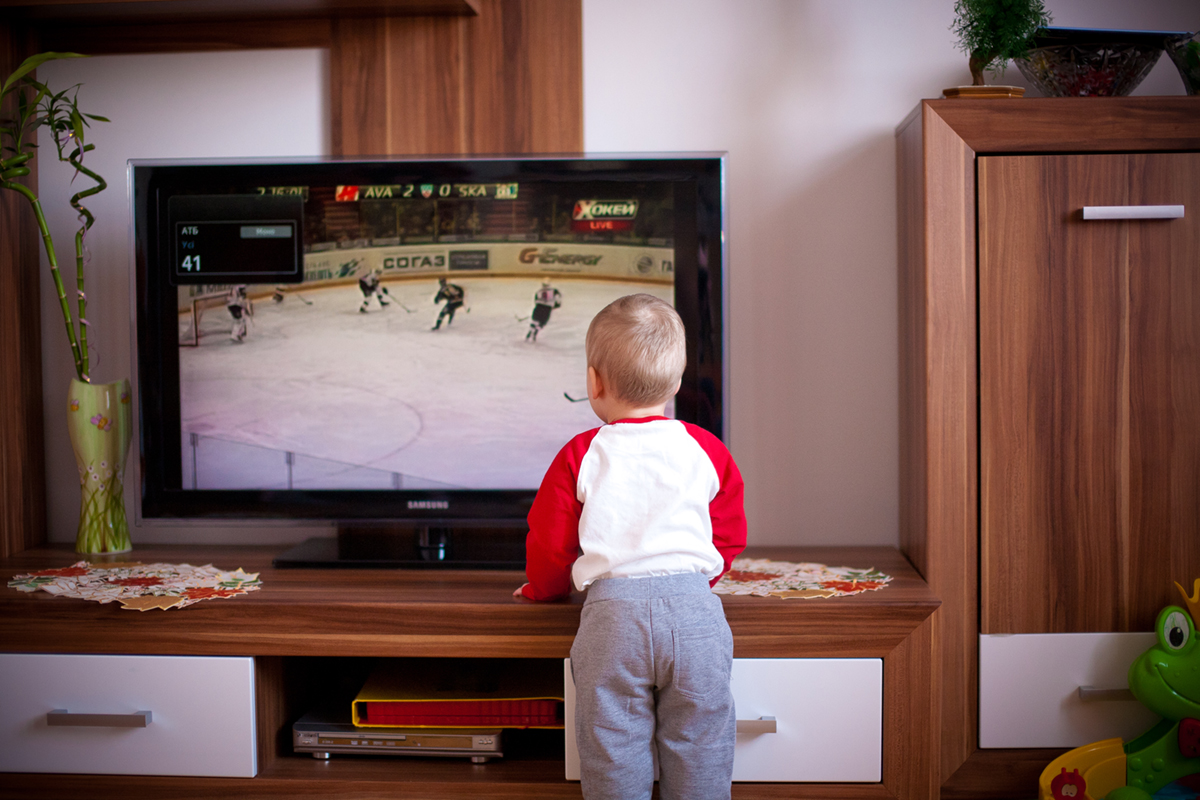
In the beginning, there were only three principal broadcast networks; today, there are hundreds of channels available. In time, television came to be accompanied with criticisms and concerns, especially because of its strong impact on children's development.
It is relatively simple for parents to provide guidance to young children concerning the amount and type of viewing, but what happens when they get a little older? How does TV impacts a child’s knowledge and behavior?
Children and Television
How much do children watch television?
Well, we are all familiar with the fact that children absorb every type of media that comes within reach, from TV to computers, video games, print media, videotapes, music… Research has confirmed that children watch television about two hours per day. It also suggests that this time spent in front of TV is significantly increasing through childhood, and it peaks at about three and a half hours per day during middle school.
Although children are classified as passionate viewers, this isn't completely true. For children, TV is just one of many other activities which is why, in the begging, children only glance at the TV content. Later on, when they start understanding it, their attention grows. Not every type of content occupies their attention with the same intensity. Some of the most attractive TV content for children is informative, signaling content that children are likely to find relevant or entertaining.
What do children really understand from all that?
For many years, experts held that children really don’t understand much of the program they are watching, at least not in their pre-school years. This was based on the fact that TV program is filled with content which requires selecting, connecting, and inferring causes of events to be understood. However, recent studies have shown that even the youngest children understand the program almost completely when it has a lot of action sequences and dialogues, especially if story events relate to children's experiences.
Certain studies have tried to prove that the time spent with television leads to a decrease in more valuable activities, and that these kids seem to spend less time engaged in activities that encourage cognitive development.
How does TV affect child’s behavior?
Since it came into our homes, television became the subject of many debates, citizens' actions, and network responses because of possible effects of violence on children. Several researches done in mid–twentieth century have tried to investigate and possibly prove the impact of media violence on children.
Albert Bandura's social learning theory was based on the fact that children could easily learn and model their behavior to what they have observed on film or television. He claimed that children who have watched programming filled with violent actions have a tendency to imitate those actions. Laboratory experiments have also demonstrated that soon after watching violent programming children are more likely to show an increase in their own levels of aggression.
Children were mostly affected by the following:
- Context and messages of violent movies
- System of punishment seen in these movies
- Reinforcement of the filmed aggressor
- The presence of an adult in the viewing context
- Real life situations
The obvious conclusion was that television does contribute to aggressive behavior. However, we must also keep in mind one very important fact: television is just one of many potential causes of aggression. There are several other factors that can affect kids, including age, sex, family practices, and the way violence is presented.
Television and cognitive development
As we’ve already concluded, television violence is a present and most visible aspect of television’s bad impact; still, we must not forget that there are also some potentially beneficial effects of television on patterns of thinking and understanding. Does television really affect children’s attention and promote passive or over-stimulated children, as some experts say? Some also claim that it literally ruins children’s creativity and imagination. The subject is complex, and difficult to answer in simple terms.
According to the theory of Active Television Viewing, children’s attention is closely linked to comprehension. When there is no comprehension involved in watching, there is a strong possibility that all TV content momentarily becomes boring, and children’s attention is deflected. The level of comprehension is closely related to the child’s age.
Children’s attention is fragmentary before the age of two and increasing constantly during preschool years. Visual attention begins to decrease around the age of eight, since at that age the understanding of the television becomes routine.
However, all children watch television from a different perspective. Studies have shown that younger children experience difficulty with a number of tasks involved in understanding television programs.
Television and children’s knowledge
Does television really affect children’s knowledge has been a question of many debates. Both parents and teachers have spoken about the possible effects of TV on children's thinking and school achievement. The base of all these debates was the so-called displacement theory. According to this theory, the time spent with television takes simply time away from more valuable activities, such as reading. Of course, there are people who oppose this theory, claiming that television has nothing but positive effects on children, keeping them “off the streets”, inside the family circle, and therefore socializing them properly.
Summing all this, we can safely say that light to moderate television viewing – assuming adequate program content, family interaction, and opportunities for other activities – leaves nothing but positive effects on kids.
Is learning from television possible?
A number of young parents are interested to find out if there is any way that children could actually learn from watching TV all the time. Again, the answer depends on the amount and type of program viewed.
Researches estimating television's ability to teach specific skills, have shown a connection between television watching and different achievements, intellectual ability, grades, and reading. There are still many unclear aspects to all this. According to experts, sometimes children who spend a lot of time in front of television do poorly in school, but children who spend moderate amounts of time with TV perform better than absolute non-viewers. In the end, we can draw one simple conclusion – although it can be highly useful for children, television can have negative effects when viewing rises above a certain level.