

Behcet's disease, which is also sometimes called Behcet’s syndrome, is an extremely rare, chronic inflammatory disorder. The cause of Behcet's disease is still unknown, although there have been some reports of a virus found in some individuals who have the disease. Behcet's disease (BD) may affect many parts of your body, with sores on your eyes and mucous membranes being the most common. These sores that you can get because of BD may take multiple weeks to go away, or just a few days.
Behcet's disease has no cure currently. However, there are some treatment plans to help you make the symptoms less severe.
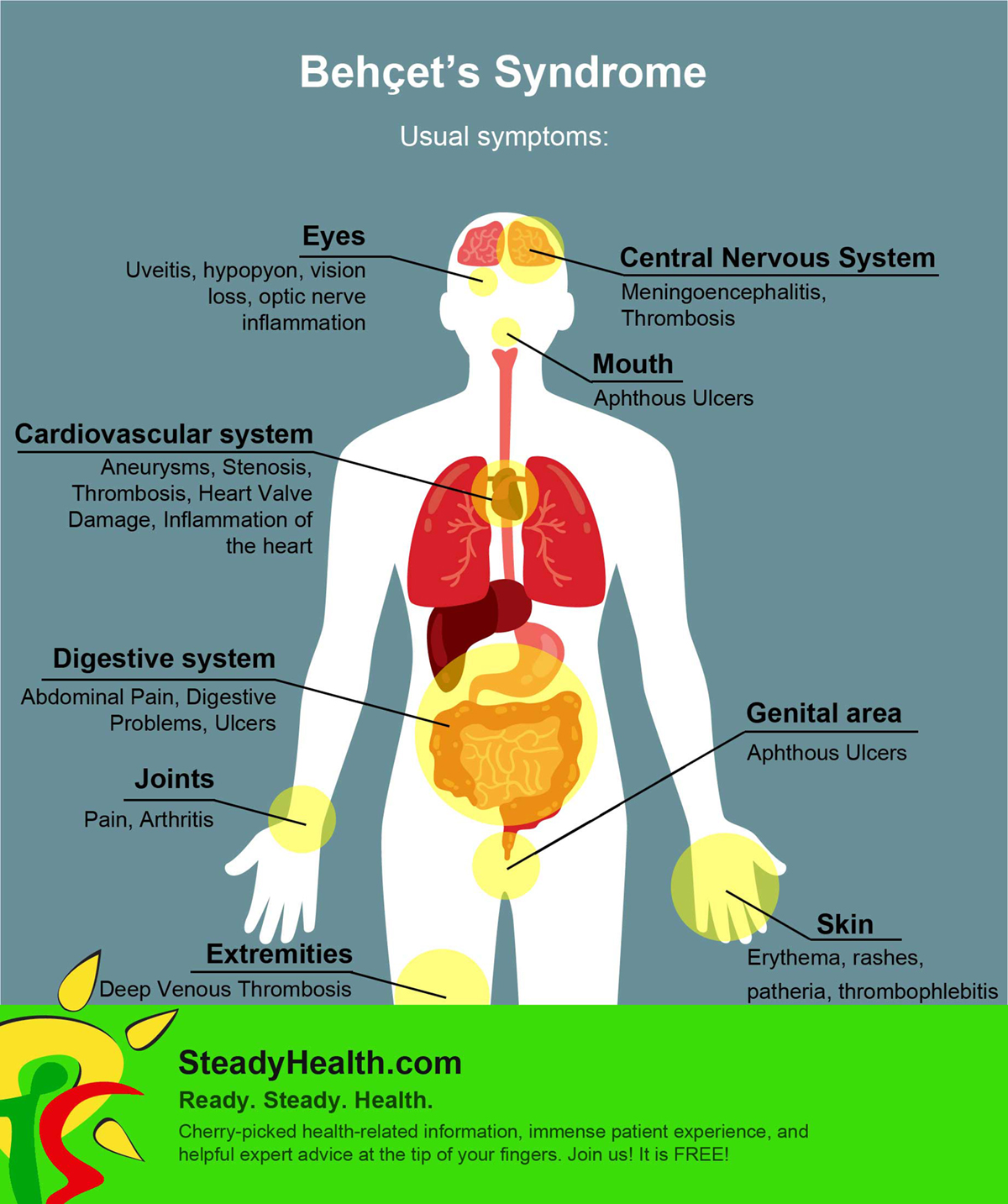
This condition is a multi-system disease, because it may involve all organs and affect the central nervous system, causing memory loss and impaired speech, balance, and movement. The effects of the disease may include blindness, stroke, swelling of the spinal cord, and intestinal complications. Although there is no cure for this disease, “incurable” does not mean “untreatable”. There are several ways in which the immune system can be suppressed to reduce the extra inflammation and relieve the symptoms.
Who’s affected?
Although Behcet's has been diagnosed in young infants and people over the age of 70, it most commonly affects people between the ages of 20 and 40. In Western Europe and North America, more women are affected than men. No-one knows for sure how many patients there are in the UK but it is estimated that there are about 2 in 100,000, that is, about 2,000 people. The disease is common in Japan, Turkey, and Israel, and less so in the United States.
Historical facts
In 1937, Hulusi Behcet, a Turkish dermatologist, described a disease characterized by inflammation of the uvea, the middle coat of the eye comprising the choroids, ciliary body, and the iris with genital and oral ulcers. Almost half a century later, Behcet's disease was recognized as a chronic multisystem disorder with vasculitis.
Possible causes
The lives of Behcet's syndrome patients are often made difficult by misunderstandings about their condition. The most common misconception is that the condition is infectious and sexually transmitted because of the ulcers on the mouth and genitals, but in fact it is not.
The cause of Behcet's disease remains unknown. Most experts are contemplating possible genetic predisposition, autoimmune mechanisms, and viral infection as possible causes which may trigger the autoimmune process, causing the body to attack its own blood vessels, making them inflamed.
Symptoms of Behcet’s disease
The symptoms of Behcet's syndrome depend on the area of the body affected. Inflammation target tissue includes the arteries that supply blood to the body's tissues and veins that take the blood back to the lungs.
The most common sites of inflammation include:
* retina
* brain
* joints
* skin
* bowels
* mouth
* genitals
The mouth and genital ulcers are generally painful and can range in size from a few millimeters to 2 cm. The mouth ulcers occur on the gums, tongue, and inner lining of the mouth. The genital ulcers occur on the scrotum and penis of males and vulva of women. Both types can leave scars.
Eyes: Inflammation of the eye can lead to blindness. Symptoms of eye inflammation include pain, blurred vision, tearing, redness, and sensitivity to bright lights.
Arteries: Possible complication of arterial inflammation can lead to death of the tissues depending on these vessels for oxygen supply.
Brain: Symptoms of inflammation of the brain include headaches, neck stiffness, and fever. This could be a serious complication, because inflammation of the brain and the meninges can cause damage to nervous tissue and lead to weakness or impaired function of some parts of the body.
Joints: Knees, wrists, ankles, and elbows are the most common joints affected. Symptoms occurring as complications of joint inflammation include swelling, stiffness, warmth, pain, and tenderness of joints.
Skin: Sometimes the symptoms are also present on the patient’s skin. It can develop areas of inflammation which appear as raised, tender, reddish areas, typically on the front of the legs. Ulcerations can appear at any location in the stomach or intestines.
Diagnosis of Behcet’s disease
* Physical evaluation
Behcet's syndrome is diagnosed based on the finding of recurrent mouth ulcerations combined with any two of the following: eye inflammation, genital ulcerations, or skin abnormalities mentioned above.
* Pathergy test
A special skin test called a pathergy test can also suggest Behcet's syndrome. This test consists of pricking the skin of the forearm with a sterile needle. The test suggests Behcet's syndrome when the puncture causes a sterile red nodule or pustule that is greater than two millimeters in diameter at 24 to 48 hours.
Other diagnostic tools which can help in setting the right diagnosis:
* skin biopsy
* lumbar puncture
* MRI scan of the brain
* bowel tests
Treatment of Behcet’s disease
There is no definitive cure for the Behcet syndrome – there is only symptomatic treatment. The treatment depends on the severity and the location of its manifestations. Several classes of medications can relieve some of the symptoms.
Those most commonly used include:
* Steroids
Steroid gels, pastes and creams (usually cortisone) can be helpful for mouth and genital ulcers, because these steroids suppress the normal or increased inflammatory response of the body. Colchicine can also minimize recurrent ulcerations and Trental® seems to maintain the healed ulcers for up to the 29 months.
* Non-steroidal anti-inflammatory drugs
Joint inflammation can require non-steroidal anti-inflammatory drugs (such as ibuprofen® and others) or oral steroids. Sulfasalazine has been effective in some patients for arthritis.
* TNF-blocking medications
Treatment of eye inflammation is essential; patients with eye symptoms should be continually monitored by an ophthalmologist.Research has indicated successful management of resistant eye inflammation with new biologic medications called TNF. TNF blocks a protein that plays a major role in initiating inflammation; infliximab (Remicade®) and etanercept (Enbrel®) can also be helpful treat severe mouth ulcerations.
* Immunosuppressive agents
Severe disease of the arteries, eyes, and brain can be extremely difficult to treat, requiring powerful medications that suppress the immune system. These medications are called immunosuppressive agents. Most commonly used agents include chlorambucil (Leuderan®), azathioprine (Imuran®), and cyclophosphamide (Cytoxan®).
* Thalidomide
Recent studies suggest that thalidomide may benefit patients with Behcet's syndrome in treating and preventing ulcerations of the mouth and genitals. It is crucial to point out that this medication is known for several serious side effects, such as promoting abnormal development of fetal growth, nerve injury (neuropathy), and hyper-sedation.
Read More: Lupus in Women: Chronic Inflammatory Disease
Behcet’s syndrome prognosis
Unfortunately, the prognosis for Behcet's syndrome is generally poor. There has been a documented case of Behcet's lasting for 17 years. Although the disease is considered painful but not fatal, when the central nervous system is involved, severe disability and death are always possibilities. The condition is usually chronic, although remissions are possible during the course of the disease.
- www.healthscout.com
- en.wikipedia.org/wiki/Behcet%27s_Syndrome
- www.behcets.org.uk
- image: ard.bmj.com